
A multi-tenant ERP for three cutting-tool manufacturers Zoho could not hold.
Three cutting-tool manufacturers in Mumbai outgrew Zoho. We built CFX, a custom multi-tenant ERP on AWS with a dedicated Android sales app and Gemini AI integration.

Quote pipeline, multi-vendor RFQ, work orders, vendor bills, and a customer dashboard. One operating system for a second-generation manufacturing firm.
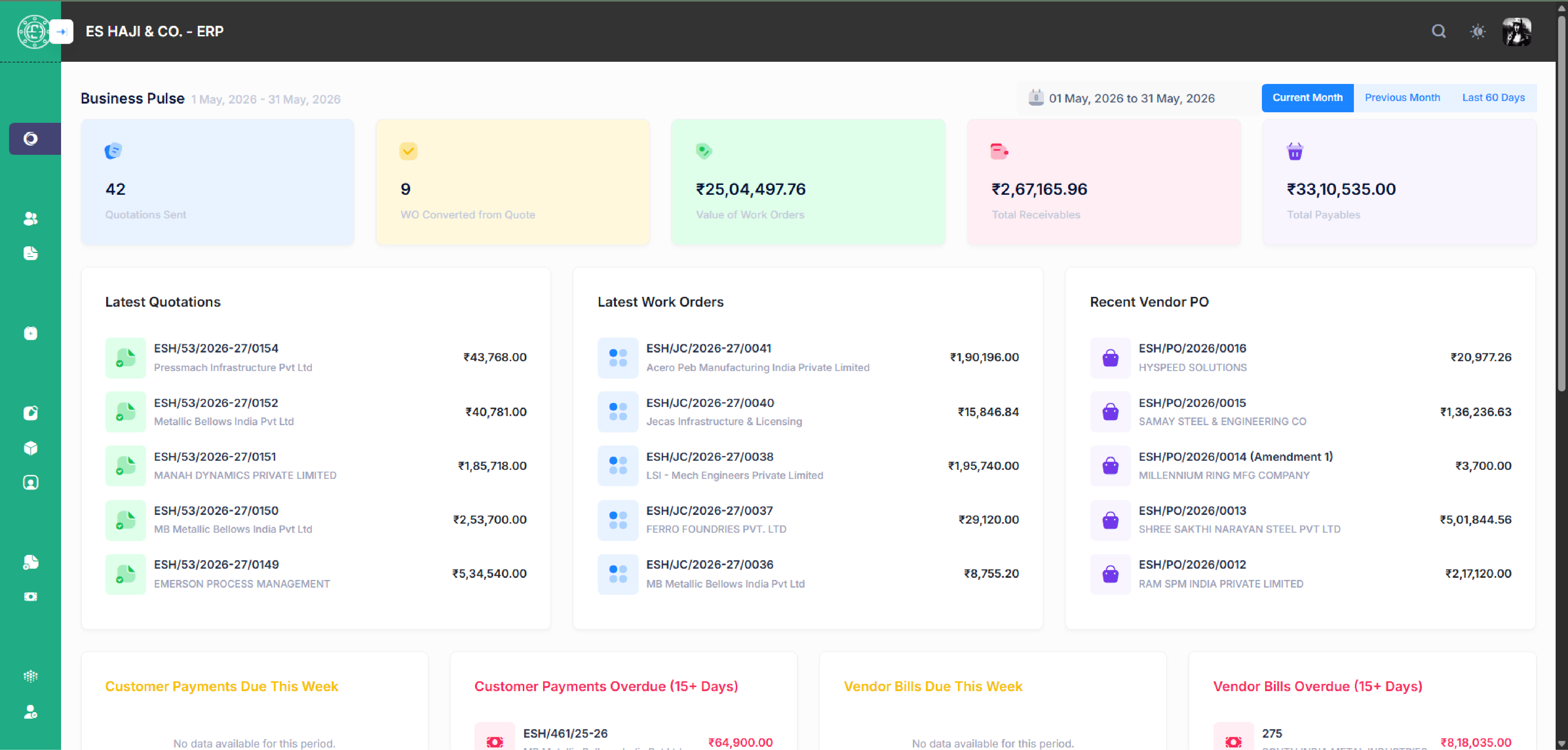
A five-month engagement that delivered one of the most comprehensive ERP systems Simply Five Studio has built. ES HAJI & CO. is an industrial manufacturer producing custom anchor bolts, flanges, and heavy hardware. Their work is technical, custom-quoted, and run through a network of material vendors. The system we built reflects that operating reality at every level.
The work was led on the client side by the second-generation founder, who had inherited the business with the conviction that the next decade of growth would require something other than the manual workflows the firm had grown up on. The first conversation was about operations, not software. By the end of it, both sides agreed on what the system needed to be, and what it explicitly did not need to be.
ES HAJI manufactures industrial hardware that customers specify rather than browse. A quote begins with a request that may carry drawings, material grades, surface treatment requirements, and quantity tiers. The estimating team translates that request into a costable specification, which depends on what raw material is available, what current vendor pricing looks like, and what the production floor can deliver in the required window.
The operational chain ran end to end in the founder's head and in the heads of two or three senior people. Quotes happened in Excel and on paper. Work orders were issued verbally or on note pads. Vendor RFQs went out as individual emails. Vendor responses came back as scattered replies that were tallied by hand. Purchase orders were typed in Word. GRN documents lived in physical files. Invoicing happened in Tally, which was reconciled monthly against the operational reality by anyone with time to do it.
Each of these pieces worked, in isolation. The problem was the coordination cost. The second-generation founder was spending more time holding the operating fabric together than running the business. The question he came to us with was not about software. It was about how to preserve the firm's operational character while removing the friction that was beginning to limit growth.
A custom ERP built around the lifecycle of a quote becoming a job becoming an invoice becoming a paid account, with the vendor side modelled as a first-class peer of the customer side.
Lead and request capture. Specification fields tailored to the product categories ES HAJI manufactures. Quotation generation with brand-correct PDFs and an email or WhatsApp share. Quote versioning so revisions sit alongside originals, not on top of them. Quote-to-work-order conversion that carries the entire specification forward without re-entry, including material grade, treatment requirements, and quantity breaks.
A work order is the unit of operational truth in the system. It carries the customer reference, the agreed specification, the material allocation, the vendor RFQs that supplied that allocation, the production timeline, and the dispatch plan. Status moves through stages that match the physical reality of manufacturing, not a generic checklist.
A first-class workflow for sending an RFQ to a curated set of vendors simultaneously. Each vendor receives an email with a link to a portal unique to them. On the portal, the vendor submits their quote with line item pricing, lead time, and any clarification notes. Their submission lands inside the ERP as a structured response, not an email body that requires manual extraction.
This single feature replaced what was previously a tally on paper across half a dozen email threads. It also gave the estimator something they had never had before: a side-by-side comparison view of incoming vendor responses, scored on price and lead time together.
When the estimator chooses a vendor, the system generates a purchase order from the selected vendor's submitted quote, with no re-entry. The PO carries the same specification the customer quote carried, which means the vendor produces against the same spec the customer agreed to. Mistakes that came from manual re-typing at this handoff, common in the old workflow, became impossible by construction.
When material arrives, the system records the GRN with the vendor bill attached. Discrepancies between PO and actual delivery surface immediately. The integration with Tally for invoicing and payment runs as a bridge, not a replacement. Tally remains the accounting system of record. ES HAJI's accountant continues to work the way they have always worked. The operational system provides Tally with clean, structured data to consume.
Customers can log into a portal and see the live status of their orders, their quote history, and their account ledger. Vendors can log in and see their open POs, their submitted RFQs, and their payment status. Both constituencies that previously needed to phone or email to get an update now have self-service visibility. The phone calls did not disappear, but the volume dropped sharply.
A reporting layer that gives the founder the operational dashboard he described in the first conversation. Quote conversion rates, vendor performance, customer aging, production throughput, margin per category. Approval workflows where high-value quotes, large POs, or vendor exceptions surface to the founder before they commit.
A request lands. The estimator captures it in the system with the full specification. An RFQ goes out to three vendors. Their responses arrive in the portal. The estimator chooses the best fit and issues the PO with one action. The customer quote is generated against the validated material cost and sent in the same session.
The customer accepts and pays advance. The work order is opened. The production floor knows what is being made, by when, with which material. Dispatch happens with documents auto-generated. The GRN reconciles the vendor's actual delivery. The invoice runs through Tally. The customer and vendor portals each show their respective views of the same underlying reality.
The founder, instead of holding all of this in his head, watches it from a single screen. The exceptions surface to him by design. The routine does not.
The operational tempo of the firm increased without the headcount changing materially. The same team produces a measurably larger volume because the coordination cost has been removed from their days.
The vendor relationship transformed. Vendors who had previously been phoned and emailed individually now have a portal that respects their time. The vendor base became easier to grow and easier to manage, which matters because vendor diversity is one of the input controls on margin in this category.
The customer-facing visibility, by itself, changed conversations. A buyer who can see live status of their order asks different questions than a buyer who cannot. The questions became higher quality and less frequent. The relationship became less transactional and more relational.
For the founder, the change was less measurable but more important. The time and bandwidth that had been spent holding the operation together became available to run it forward. The five months of build were recovered in productive founder hours within the first six months of operation.
A web application on the firm's preferred stack. PostgreSQL for the operational record. The Tally integration runs as a bridge with explicit mapping, not as an opinionated transformation, because the accountant's mental model of Tally is more important than a clever automation. The vendor portal sits on the same database as the internal ERP, with row level access scoped per vendor so each sees only what they should.
The decision to keep the system as a single web application, rather than split into a customer portal product and an internal product, came from the founder's instinct that the data was the value, and the data should sit in one place. Two portals on top of one database, not two products with synchronisation problems.
The system continues to evolve under a long-term technology partnership. Recent additions deepen the financial reconciliation between operations and Tally, and refine the reporting around vendor performance. The roadmap continues to track the founder's operating priorities, which shift as the firm itself shifts.
Three cutting-tool manufacturers in Mumbai outgrew Zoho. We built CFX, a custom multi-tenant ERP on AWS with a dedicated Android sales app and Gemini AI integration.
A highly custom ERP with AI capabilities to remove manual workflows from the operation. Modules for customer management, HR, online portal automation, and custom quotations.
AK Suppliers & Distributors run a WooCommerce storefront integrated with a custom ERP we have evolved alongside their business for the last four years. The current stack is modern and entirely self-hosted.
Engagements begin with a conversation. Not a pitch. A direct discussion about your operations and the visibility you are missing.