A multi-tenant ERP for three cutting-tool manufacturers Zoho could not hold.
Three cutting-tool manufacturers in Mumbai outgrew Zoho. We built CFX, a custom multi-tenant ERP on AWS with a dedicated Android sales app and Gemini AI integration.

Customer customisation, online payment, and a 24-hour fulfillment loop. A print-on-demand operation captured in a single web application.
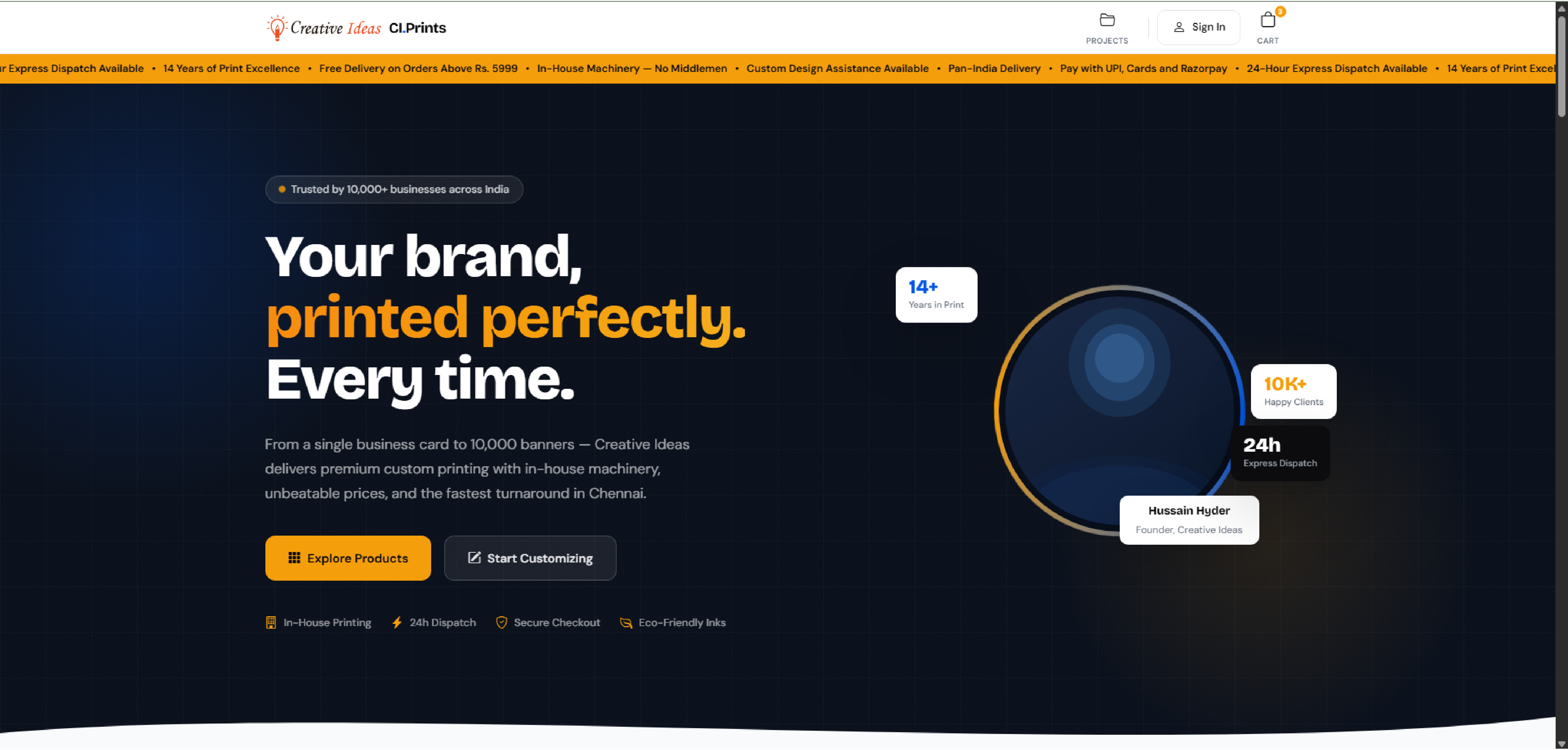
Creative Ideas operate a print-on-demand business. Customers come in through the web, customise their requirements (size, format, finish, quantity), pay online, and receive their finished prints within twenty-four hours.
The brief was straightforward but had a tight operational requirement embedded in it. The system needed to capture the customer's specifications cleanly enough that the production floor could begin work without further clarification. The 24-hour turnaround did not have the slack to absorb back-and-forth on what the customer actually wanted.
Print on demand is a category where the customer specification is the product. There is no generic SKU to ship. Each order is unique, defined by what the customer configured. The supplier's job is to translate that configuration into a print job, produce it, and deliver it on schedule.
In the old workflow, customer requirements arrived through informal channels (phone, WhatsApp, email) and needed to be translated by the team into structured print specifications. The translation step was where things went wrong. A customer's idea of what they wanted did not always match what the team understood, and the gap surfaced at the worst possible moment, on the production floor.
The brief was to move the customer specification into a structured online process that produced unambiguous output for the production floor.
A web storefront and order management system.
The customer flow walks through the available print options in a way that builds up a complete, valid specification. Size, format, paper or material choice, finish, quantity, and any custom upload all happen inside the application. The customer sees what they are configuring and confirms the choices before they pay.
Payment integrated into the order flow. The order does not enter the production queue until payment is confirmed, which removes the operational risk of starting work on an order that may not be paid for.
The production team sees confirmed orders in their queue with the full specification attached. There is no ambiguity about what to produce. The team can move orders through production stages, mark them ready for dispatch, and complete them when delivered.
The whole system is built around the commitment to a 24-hour turnaround. Orders are timestamped. The queue surfaces what is approaching deadline. The fulfillment team works against the queue with clear priority.
A customer lands on the storefront, configures their print job, pays, and receives confirmation. The order arrives in the production queue. The team begins work, completes the print, and dispatches it. The customer receives notification that their print is ready or has been dispatched. The cycle closes within the day.
The clarity at the start of the cycle (because the customer self-configured a complete specification) eliminates the slow, error-prone translation step that used to consume team time and create production-floor problems. The team's focus shifts to producing well, which is the work the business is built on.
The translation overhead between customer requirement and production instruction collapsed. The team no longer spends time figuring out what the customer meant. The specification is complete by construction because the customer themselves authored it.
The 24-hour commitment became reliably deliverable. The combination of clear specifications and a structured production queue gave the team the operational predictability they needed to meet the turnaround window consistently.
The customer experience became more confident. A customer who can configure exactly what they want and see the result they are paying for makes the buying decision more comfortably than a customer who has to explain their requirement to a salesperson over WhatsApp.
A web application on the firm's preferred stack. The choices were straightforward for a project of this profile and have served the business reliably since deployment.
Three cutting-tool manufacturers in Mumbai outgrew Zoho. We built CFX, a custom multi-tenant ERP on AWS with a dedicated Android sales app and Gemini AI integration.
A highly custom ERP with AI capabilities to remove manual workflows from the operation. Modules for customer management, HR, online portal automation, and custom quotations.
A comprehensive ERP for an industrial manufacturer of custom anchor bolts, flanges, and heavy hardware. Quotes to work orders to invoicing, multi-vendor RFQ, vendor and customer dashboards.
Engagements begin with a conversation. Not a pitch. A direct discussion about your operations and the visibility you are missing.