
A multi-tenant ERP for three cutting-tool manufacturers Zoho could not hold.
Three cutting-tool manufacturers in Mumbai outgrew Zoho. We built CFX, a custom multi-tenant ERP on AWS with a dedicated Android sales app and Gemini AI integration.

From 45 minutes of manual calculation to 6 minutes of structured input. The founder's biggest revenue source, no longer the team's biggest bottleneck.
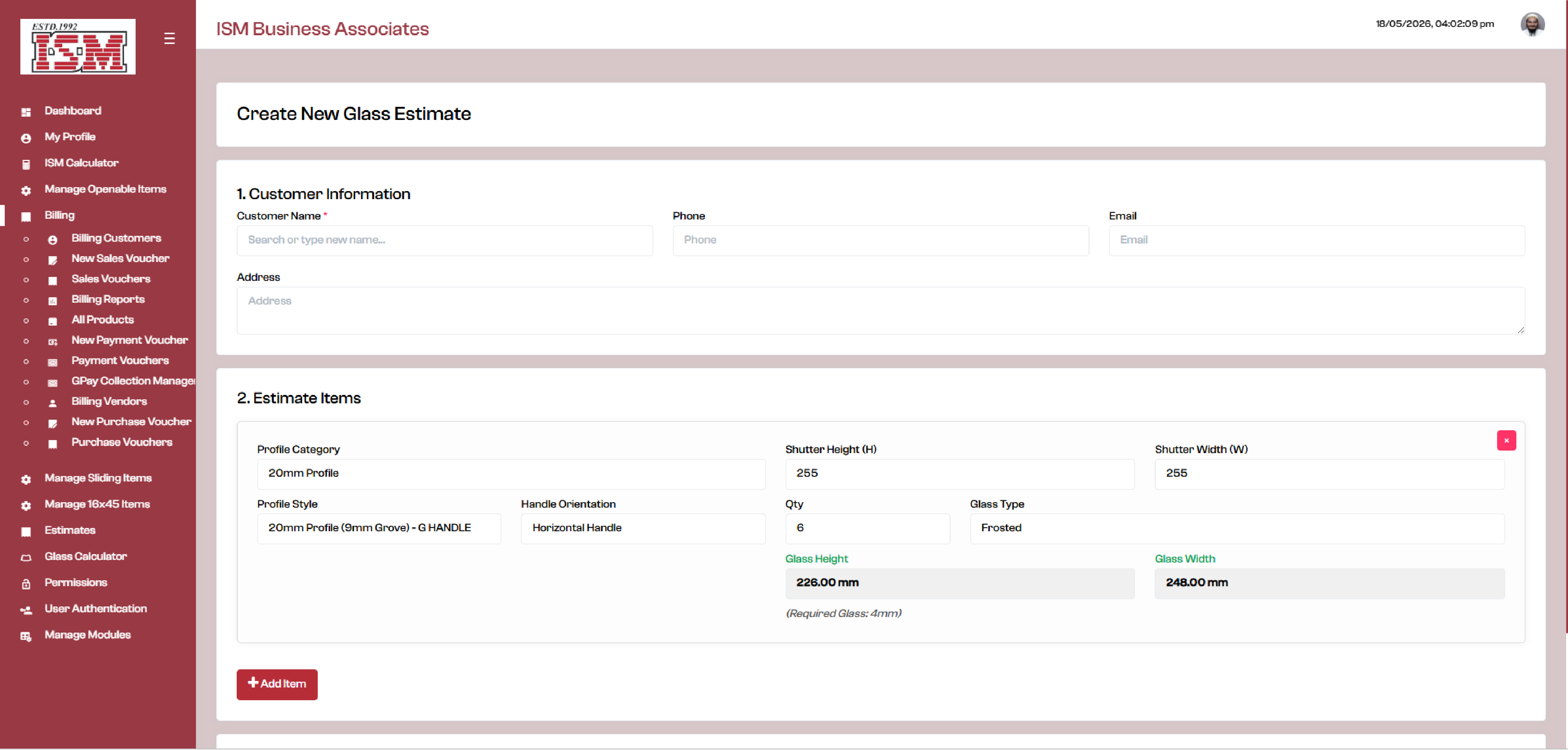
ISM Business Associates supplies custom interior hardware to customers across India. Custom-fit doors, windows, and the fittings that connect them. The founder is deeply involved in the day-to-day operation, which is both the firm's competitive advantage and, until recently, its scaling constraint.
The biggest revenue line is customised fittings. Each job begins with a customer's space measurements and ends with a detailed quotation that accounts for material cuts, waste, and reusable offcuts. The problem the founder came to us with was straightforward to describe and harder to solve. A single quotation took the team forty-five minutes of careful manual calculation. With volume growing, that calculation cost was becoming the binding constraint on how many opportunities the firm could pursue.
The work we did with ISM is one of the clearest examples of how the right narrow tool, built carefully, can move a whole business.
In the interior hardware category, customers do not buy standard sizes. They buy a configuration of standard-length profiles that have been cut to fit a specific opening, with the appropriate hardware (dividers, handles, connectors) attached. The supplier's job is to take the customer's measurements, work out which profiles to cut, calculate the cuts efficiently, account for waste, identify offcuts that can be reused on the same job, and then assemble a quotation that itemises material, labour, and any extras.
The skill of doing this well lives in the estimators' heads. They know the standard profile lengths. They know which cuts are economical and which produce unusable offcuts. They know how to combine measurements across a single quote to minimise waste. They know which hardware specifications match which profile configurations.
What they did not have was a way to capture that skill in a system that removed the manual arithmetic. Every quote required the estimator to do the same calculation, by hand, on a calculator and a notepad, every time. With a careful estimator, the result was accurate. With a tired or distracted estimator, it was a source of margin leak. With volume growing, it was a cap on how much work the firm could quote in a day.
The founder wanted to remove the calculation overhead without removing the estimator. The expertise was real and valuable. The arithmetic was the bottleneck.
A custom calculator and quotation module inside the firm's ERP. The estimator's role changes from arithmetic to specification. They tell the system what the customer needs. The system does the cutting plan, the waste accounting, the offcut tracking, and the quotation assembly. The output is a detailed, accurate quote in about five to seven minutes from first input.
The estimator inputs the dimensions of each door or window in the customer's space. The system knows the standard profile lengths it has to work with, knows the connector and hardware requirements, and knows the rules for reusing offcuts within a job. It computes a cutting plan that minimises waste, flags where waste is unavoidable, and surfaces the offcuts that can be used for subsequent items in the same quote.
Each cut is itemised. The estimator can see what is being made from where, and why. The transparency matters because the customer occasionally asks, and the estimator needs to be able to explain. The calculator does not hide its arithmetic. It speeds up its arithmetic.
The cutting plan rolls up into a structured quotation. Material costs, hardware costs, finishing costs, labour estimate, and waste allowance all itemise cleanly. The PDF is brand-correct and customer-ready. The quote is versioned so the inevitable rounds of revision do not destroy the original.
The system also stores the quote against the customer record, which means the next time the customer comes back for a similar job, the prior estimate is available as a reference. The estimator's institutional memory becomes a queryable resource, not a personal one.
The calculator and quotation module is the most visible part of the work, but it sits inside a wider operational system. Customer records, quote history, project status, and material usage tracking all run together. Several smaller calculator modules support adjacent product categories. The firm now has a single operational surface that knows what is being quoted, what is being made, and what is being delivered.
A customer enquiry comes in. The estimator opens the calculator, captures the space dimensions and the customer preferences, and works through the quote with the customer on the call. Where previously they would have asked for time to work the numbers and come back, they now produce a working draft live. Customers experience a faster, more confident interaction.
For larger jobs, the estimator may iterate two or three times with the customer on configuration and material choices. Each iteration is fast, which means more configurations get explored, which means the final order more often reflects what the customer actually wanted. The founder reports that the win rate has improved, which is consistent with this dynamic, although the firm does not yet measure win rate analytically.
The forty-five minutes that the team used to spend on each quote becomes six. The five minutes that becomes six is not the same kind of five minutes. It is the part that requires human judgement, not arithmetic.
The most obvious change is the time per quote. Forty-five minutes to six minutes is an eighty-six percent reduction. For a firm that produces multiple quotes a day, the cumulative effect on team capacity is substantial.
The less obvious change is the consistency. Manual calculation, however careful, varies estimator to estimator and day to day. Systemic calculation is consistent. The waste estimates are accurate. The cutting plans are efficient. The margin on a quote no longer depends on which estimator wrote it.
The third change, harder to attribute precisely but visible in the founder's account, is the speed of the customer-facing conversation. A firm that can quote on the call instead of getting back the next day presents differently to the buyer. The buyer's sense that the supplier is on top of their work is shaped by small interactions like this.
The relationship with ISM continues. The calculator module has been extended for additional product categories as the firm has added them. The next focus is on capturing the operational data the system now generates and turning it into the kind of margin and category analysis the founder did not previously have access to. Knowing what your most profitable product lines actually are, after waste and rework, is the next layer of decision infrastructure.
Three cutting-tool manufacturers in Mumbai outgrew Zoho. We built CFX, a custom multi-tenant ERP on AWS with a dedicated Android sales app and Gemini AI integration.
A highly custom ERP with AI capabilities to remove manual workflows from the operation. Modules for customer management, HR, online portal automation, and custom quotations.
A comprehensive ERP for an industrial manufacturer of custom anchor bolts, flanges, and heavy hardware. Quotes to work orders to invoicing, multi-vendor RFQ, vendor and customer dashboards.
Engagements begin with a conversation. Not a pitch. A direct discussion about your operations and the visibility you are missing.