
A multi-tenant ERP for three cutting-tool manufacturers Zoho could not hold.
Three cutting-tool manufacturers in Mumbai outgrew Zoho. We built CFX, a custom multi-tenant ERP on AWS with a dedicated Android sales app and Gemini AI integration.

WhatsApp and phone orders gone. Every order now flows through a structured customer portal and a single admin backend with merge, ship, and report tools.
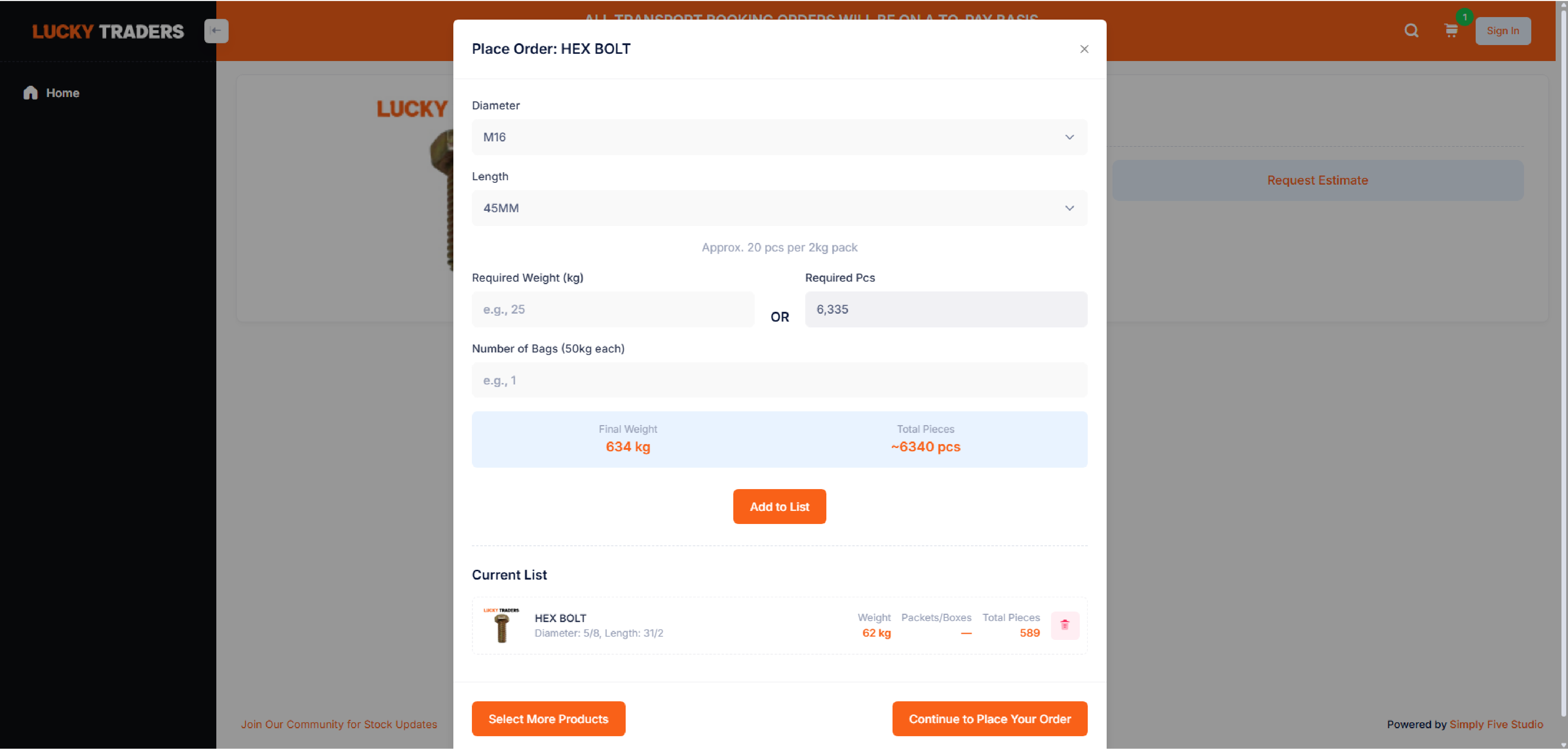
Lucky Traders distribute hardware fasteners to a trade customer base. Their customers know exactly what they need: specific bolts, screws, washers, and assemblies in specific quantities that match the parameters the trade requires. The product category does not need to be discovered. It needs to be ordered cleanly, fulfilled accurately, and tracked reliably.
The brief from the founder was the kind that signals a buyer who has internalised the cost of the current state. Their entire order intake ran on WhatsApp messages and phone calls. The team spent their day translating informal requests into structured orders, deciphering handwriting, calling back to confirm SKUs, and reconciling what was actually shipped against what was actually said.
The project replaced that channel with a customer-facing application and an admin backend that handle every order through one structured surface.
In a hardware fastener business, customers reorder constantly. The same trade buyer might place several orders a week, each for the same dozen or so SKUs, with quantities that vary by current job. The product itself sells on parameters (head type, thread pitch, finish, length, diameter, quantity per pack) that need to be specified correctly for the order to be useful.
Selling this category on WhatsApp produces predictable failure modes. A customer types out their requirement. The team has to parse it. They respond with availability and a confirmation. The customer adds a line item they forgot. The team updates the order. The order goes out. Sometimes correctly. Sometimes with an error that the customer flags on delivery, which then requires a credit, an exchange, or a callback.
The founder was running a real business through a chat interface that was never designed for it. The customer experience was inconsistent. The team's time was consumed by parsing and reconciliation. The opportunity to grow was capped by the operational cost of every additional order.
The decision to build a customer-facing application came with a specific commitment: every order, without exception, would flow through the new surface. WhatsApp and phone would not be parallel channels. They would be migrated out.
A customer-facing application and an admin backend that share one database, designed around the way fastener orders actually work.
Each trade customer logs into the application with their own account. They see the product catalogue presented in the way fastener buyers expect to see it, with the parameters (size, finish, packaging quantity) that decide what they buy. Search and filtering match how the trade thinks about the products, not how a generic ecommerce template thinks about them.
For each product, the customer selects the quantity in the units the vendor offers. Pack sizes, minimum order quantities, and quantity tiers are all surfaced so the customer makes the right selection the first time. The friction that previously produced misorders is removed by construction.
The customer reviews their cart, confirms, and submits. The order lands in the admin backend as a structured record. The customer receives an automated email and PDF confirmation of what they ordered. The admin team sees the order in their working queue.
A comprehensive order management surface. The team can review, edit, merge, split, and progress orders through fulfilment stages. Where a customer has placed multiple small orders that need to ship together, the merge function combines them. Where shipping details need to be updated, the team updates them once and the customer sees the change.
Every order generates a PDF that goes to both the customer and the admin. The admin team has a clean audit trail. The customer has a record they can reference. The slip system that traditional Indian SMB distribution depends on is replaced by a digital record with the same function and none of the fragility.
The admin can run reports on order volume, customer activity, and fulfilment performance. The data that was previously trapped in WhatsApp threads now sits in a database, available for analysis.
A trade customer needs a batch of bolts and washers for a job. They open the application, find the SKUs they need, set the quantities, and submit. The order arrives in the admin queue with all the structured data already in place. The team confirms availability, processes the order, and ships it. The customer receives PDFs and notifications at each step.
Where previously the same order would have started with a WhatsApp message, required several rounds of clarification, and consumed fifteen minutes of team time to translate into a fulfilment instruction, it now takes the customer two minutes to place and the team two minutes to process. The cumulative effect across hundreds of orders per week is substantial.
For complex situations, the admin tools (merge, split, edit) handle what would previously have been worked out in a chat conversation. The operational record stays clean. Nothing depends on someone remembering to update a separate place.
The most direct change is the elimination of the WhatsApp and phone order intake. Every order now flows through the structured surface. The team no longer spends their day parsing informal requests.
The accuracy of order fulfilment improved. Where customers used to occasionally receive the wrong quantity or the wrong variant of a SKU, the structured selection makes those errors much harder to produce. Returns and credits dropped accordingly.
The customer experience changed quality. Trade buyers, who were initially sceptical about being moved off WhatsApp, adopted the application because it produced more reliable orders. The same buyer who used to phone every week now places their order from the application in the same time it used to take to make the call.
The founder reclaimed time. Where the WhatsApp and phone channels demanded their attention because exceptions needed to be resolved, the admin backend now surfaces only the genuine exceptions. The routine runs itself.
The relationship continues. New modules are added as the business's needs evolve. Recent and upcoming work focuses on deeper reporting (which customers are growing, which SKUs are moving) and on tighter integration between the customer-facing application and the fulfilment operation.
Three cutting-tool manufacturers in Mumbai outgrew Zoho. We built CFX, a custom multi-tenant ERP on AWS with a dedicated Android sales app and Gemini AI integration.
A highly custom ERP with AI capabilities to remove manual workflows from the operation. Modules for customer management, HR, online portal automation, and custom quotations.
A comprehensive ERP for an industrial manufacturer of custom anchor bolts, flanges, and heavy hardware. Quotes to work orders to invoicing, multi-vendor RFQ, vendor and customer dashboards.
Engagements begin with a conversation. Not a pitch. A direct discussion about your operations and the visibility you are missing.